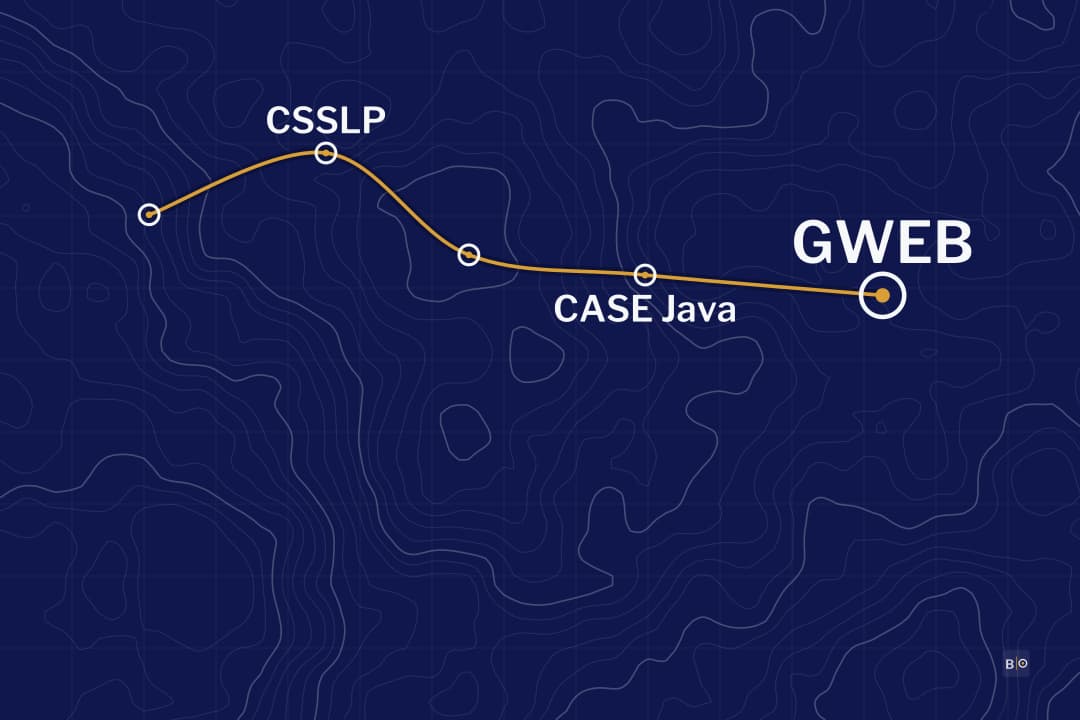
An application-security practitioner helps a team prevent defects, find important weaknesses and verify repairs without losing the connection to how software is delivered. Testing is one part of that responsibility. Choose a credential around the work you need to own: lifecycle decisions, secure Java implementation, web defenses or a focused assessment. Begin with a small application change whose security outcome you can explain.
Follow a change through the delivery process
Choose an application and a feature you may inspect. Record the requirement, relevant design decisions, implementation, test and deployment path. Identify who can approve a security exception and who maintains the feature afterward. A scanner's output is easier to interpret when the team understands what the feature is supposed to do.
For a demonstration project, use synthetic accounts and records. Include a security requirement that can be checked, such as one user being unable to read another user's private resource. Explain which component enforces it and how the test reaches that component. Avoid presenting a hidden button as proof that a backend authorization check exists.
We would ask a developer to review the explanation and reproduce the test. The purpose is learning the delivery conversation as well as the flaw. A finding that nobody can reproduce or act on is incomplete professional work even if the underlying observation is correct.
Use frameworks for the question they answer
NIST's Secure Software Development Framework supplies practices that can be incorporated into software development. OWASP SAMM provides a model for evaluating and improving a software assurance program. Neither is a personal certification obtained by reading the document, and neither turns every team into an identical workflow.
Use SSDF to examine how security practices fit the application's development process. Use SAMM when the question concerns the program's current capabilities and priorities. A maturity discussion should lead to a feasible improvement rather than a score copied into a presentation without an owner.
OWASP's Application Security Verification Standard gives another type of resource: requirements for verifying application controls. Use a relevant requirement to make a proposed test precise. Keep framework alignment separate from evidence that the control works in this implementation.
CSSLP fits responsibility across the lifecycle
CSSLP covers secure software concepts, lifecycle management, requirements, design, implementation, testing, operations and supply-chain responsibilities. ISC2 requires relevant professional experience for the full certification. It can fit an experienced developer or security practitioner coordinating decisions across delivery rather than only examining a finished web application.
Compare the published outline with a feature's actual path through your organization. Identify where you can already explain the decision and where another owner needs to help. That map can organize study while exposing a process problem that no exam will resolve by itself.
We would choose it when the learner needs that breadth of responsibility. Keep certification eligibility distinct from passing the exam, especially for someone early in their career. A staged learning plan can build the required knowledge and experience without describing a future professional credential as already held.
CASE Java focuses the development context
EC-Council's CASE Java is a real application-security credential for the Java development context. Its course material follows security through development activities. Read the current objectives against the frameworks and components you actually use, including older technology named in the syllabus.
Choose it when the Java-specific scope closes a gap in your work. A developer using another ecosystem should not assume the credential's title makes every implementation equally relevant. Compare the content before purchasing rather than choosing an acronym because it sounds like the desired job.
Pair the study with a code change you can review safely. Explain the original condition, the implemented defense and the regression test. Include how an ordinary authorized user still completes the task. Security work should improve the intended behavior without creating an unexplained operational failure.
GWEB emphasizes web application defense
GIAC's Certified Web Application Defender addresses defensive web-security knowledge. Its published objectives can support practitioners building or evaluating controls around common application weaknesses. It is a useful comparison point for someone who needs to prevent or repair issues rather than only demonstrate exploitation.
For a learning project, select a control and show how it is enforced across the relevant paths. A validation function in one endpoint does not establish that another route handles the same input safely. Keep the tested scope explicit and look for the boundary where the defense must operate.
A practical testing credential can complement that work, but it serves a different assessment purpose. The web application certification guide compares those options. There is no need to take both branches before contributing to a reviewed application-security task.
Learn to prioritize a finding with the owner
A report should explain the affected resource, prerequisite conditions and plausible consequence. Include enough evidence to reproduce the problem without exposing unrelated confidential information. Distinguish an observed weakness from an attack chain that remains hypothetical.
Discuss the proposed response with the team that will maintain it. A temporary restriction, a code repair and a design change create different work. Record the decision and the conditions under which it will be revisited. The point is a justified outcome rather than forcing every finding into the same severity and remediation template.
After a fix, repeat the relevant test and check for a regression in the ordinary path. Keep the result with the change record. A closed ticket or merged patch is evidence of process progress, while a verified behavior change establishes something different.
We would choose the next credential from the recurring gap in that work: CSSLP for lifecycle breadth, CASE Java for the relevant development context or GWEB for web defense. A useful portfolio follows a feature from requirement to tested repair and names the limits of the review. It gives an employer something more concrete to assess than a list of courses completed without a delivery outcome.
Sources
- NIST SSDF: software development practices, checked October 2026
- OWASP SAMM: software assurance program model, checked October 2026
- OWASP ASVS: application control verification, checked October 2026
- ISC2 CSSLP outline: lifecycle domains and experience requirements, checked October 2026
- EC-Council CASE Java: Java-specific application-security route, checked October 2026
- GIAC GWEB: defensive web-security objectives, checked October 2026