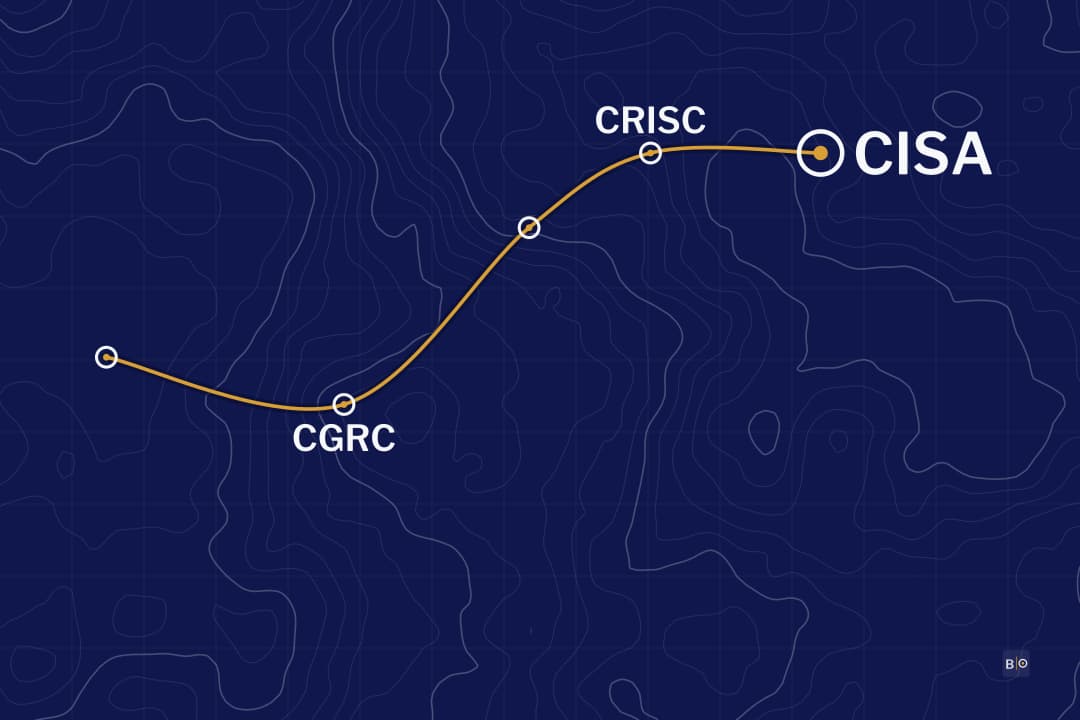
Governance, risk and compliance work connects security decisions with the people accountable for them. The right credential depends on which part you perform: assessing a system, managing IT risk, auditing controls or directing a security program. Start with that responsibility. A general GRC label can hide large differences in the experience needed and the evidence you will be expected to produce.
Follow a decision from requirement to evidence
Consider a service that gives administrators privileged access. Someone determines the requirement, someone implements the control and someone checks whether it works. A risk owner decides what to do with an unresolved weakness. Those responsibilities need coordination, but they should not be collapsed into a single activity called compliance.
Governance concerns direction and accountability. Risk work examines what could affect objectives and how to respond. Compliance work addresses applicable requirements and evidence. These are useful working distinctions for choosing study; the division of responsibilities in an actual organization should be confirmed with its owners.
Use a bounded example to test your understanding. Write the requirement, the control, the evidence and the decision that remains open. If you cannot explain who owns that decision, another framework mapping will not solve the problem. The NICE Workforce Framework can help translate broad job titles into more specific tasks.
Use frameworks according to their purpose
The NIST Cybersecurity Framework organizes cybersecurity outcomes. Its Risk Management Framework, described in SP 800-37, provides a lifecycle approach to managing system security and privacy risk. These references can work together, but they are not interchangeable names for a certification program.
ISACA's COBIT concerns governance and management of enterprise information and technology. ISO/IEC 27001 specifies requirements for an information security management system. Learn why the organization uses each reference before building a control mapping. A shared word such as access does not establish that two requirements have identical scope or evidence needs.
Keep the original requirement when you map it. Record the source, the systems it applies to and any interpretation approved by the appropriate owner. A mapping can reduce duplicated work, but it should not erase a requirement that needs a separate check. Treat software suggestions as proposals requiring review.
Choose CGRC for system controls and assessment
CGRC, formerly CAP, is ISC2's governance, risk and compliance qualification. Its outline follows control and risk responsibilities across a system lifecycle and references multiple frameworks. It fits practitioners who help scope controls, assess implementation and support risk decisions about systems.
The full credential has a professional experience requirement. Check that requirement before buying an exam on the assumption that passing will immediately make you certified. If you use an Associate of ISC2 route, describe that designation accurately and follow the issuer's application rules.
Prepare with a control assessment rather than only vocabulary. Define the intended control, the evidence needed and the limitations of the test. Explain what result would justify a finding and who should respond. The NIST framework credential guide separates framework study from a claim of NIST-issued certification.
Choose CRISC for risk assessment and response
CRISC is relevant when you identify IT risk scenarios, evaluate them with owners and follow treatment and reporting. It is a different emphasis from collecting evidence for an audit. A practitioner should be able to explain the scenario and assumptions behind a risk entry, not only maintain its rating field.
ISACA's detailed experience support page distinguishes requirements by exam date. Current applicants passing under the post-November-2025 rules need qualifying work in both risk assessment and risk response and reporting, with no experience waivers. Read the current rule and your exam-date category before planning certification.
For study, use NIST SP 800-30 as a reference for risk assessment. Write a scenario that includes the asset or activity affected, the conditions and the potential consequence. Then explain what information would change the assessment. Avoid invented financial loss figures offered only to make a register look precise.
Choose CISA for assurance and CISM for program management
CISA fits information systems audit and assurance. Its experience rules include specified qualifying work and substitutions. Preparing for it should improve how you plan an assessment, test evidence and report a defensible finding. It does not give universal authority to issue every kind of assurance report.
CISM fits security program management. The management experience rule is part of the qualification, so it should not be marketed as a beginner's GRC badge. A manager needs to connect findings and risk decisions with the program's priorities, resources and accountability.
CGEIT concerns enterprise IT governance. Consider it where your work includes governing investments and information technology across an enterprise, rather than treating it as the automatic next exam after CISM. Its experience requirements belong to that broader governance role. None of these credentials replaces the responsibility delegated by an employer.
Select the gap you need to close next
A newcomer should first understand common controls and learn to examine evidence. An operator moving into risk can build from knowledge of how controls fail. An auditor moving toward governance may need experience with decisions and outcomes beyond individual findings. Use that starting point to select a syllabus instead of following a universal badge ladder.
Compare the issuer's outline, experience application and renewal policy before purchase. Then choose a practical artifact to produce while studying: a scoped assessment, a risk scenario or a decision paper. Use approved or synthetic information and make the limits visible.
Our preference is a credential linked to a responsibility you can practise and explain. When a GRC qualification sounds equally suitable for every job, narrow the question. Identify the next decision you need to support, who owns it and what evidence will make the decision better.
Sources
- NICE Framework: role and task planning, checked October 2026
- NIST Cybersecurity Framework: cybersecurity outcomes, checked October 2026
- NIST RMF: system risk lifecycle, checked October 2026
- NIST risk assessment: risk assessment reference, checked October 2026
- ISACA COBIT: enterprise information and technology governance, checked October 2026
- ISC2 CGRC: system control credential, checked October 2026
- ISACA CRISC experience: date-specific experience requirements, checked October 2026
- ISACA CISA: audit qualification, checked October 2026
- ISACA CISM: management qualification, checked October 2026
- ISACA CGEIT: governance qualification, checked October 2026
- ISO/IEC 27001: management system standard, checked October 2026