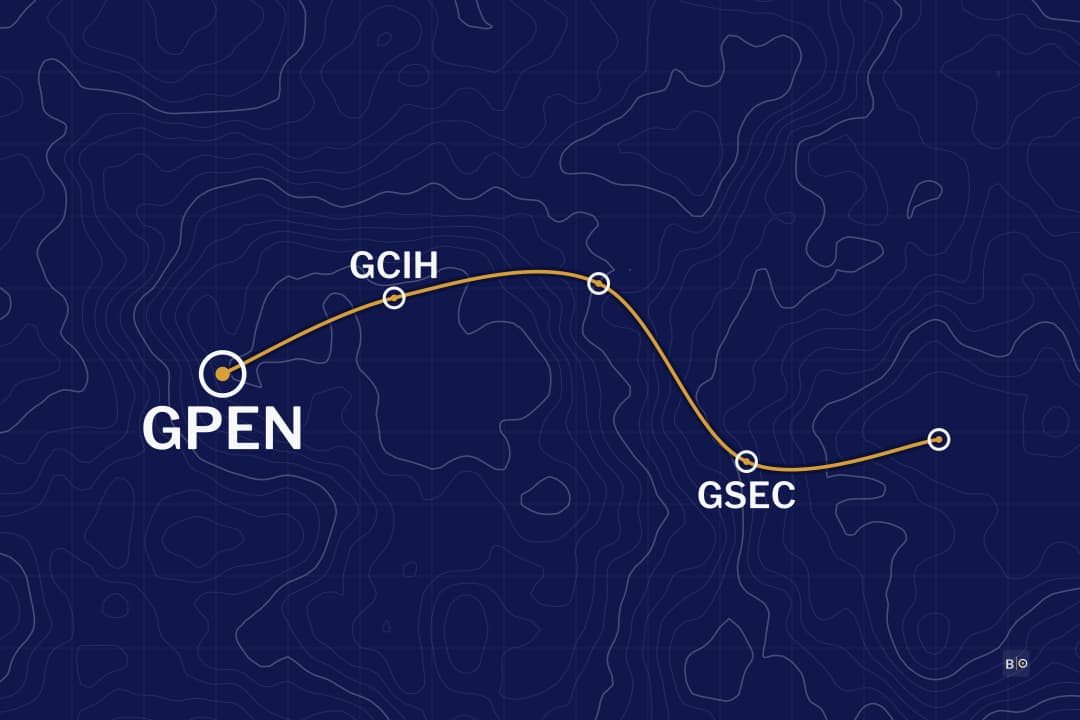
Choose a GIAC certification by the evidence or systems you expect to work with. GSEC covers broad security practice, GCIH suits incident handling, GPEN tests penetration testing and GCFA focuses on advanced forensic analysis. Those are different directions, and you do not need to buy all of them. Price the exam separately from SANS training before deciding what your learning budget can support.
Separate the course from the credential
GIAC administers certifications; SANS supplies closely related training. The course and exam are separate purchases unless your offer explicitly bundles them. A course registration should not be assumed to include certification, and the certification objectives remain the scope to check when you prepare independently.
GIAC's pricing page lists US$999 for each of the GSEC, GCIH, GPEN and GCFA practitioner attempts, with US$899 retakes and US$499 renewals. Some other credentials have different prices. SANS course pricing adds a much larger expense: its FOR500 and FOR572 pages, for example, show US$8,780 for the listed US-dollar offerings. Check the particular location, delivery mode and tax treatment before comparing proposals.
For an employer, ask what the training will let you do afterwards. A useful request names a task the team needs covered and a way to assess it. A general claim that a course will make the team more secure is difficult to evaluate. An investigation write-up or a repeatable test procedure gives a manager something concrete to review.
Start with GSEC when the foundations are uneven
GSEC covers practical security across operating systems, networks, access controls, cryptography and monitoring. GIAC's audience includes new security professionals with an information systems or networking background. It can suit an administrator whose knowledge comes from maintaining one environment and who wants to fill gaps around it.
Use the objectives as a diagnostic. Can you explain the access controls on a Windows host, identify useful logs and describe the network traffic around an application? If several of those areas are unfamiliar, a broad course can be a sensible investment. If they already describe your everyday work, choose a more focused credential instead of treating GSEC as compulsory admission to the rest.
Preparation should include executing the tasks, with notes on results and mistakes. A collection of definitions is less useful when you have to interpret a host configuration or a tool's output. Keep an index of the material you use, but spend time finding out whether you can apply it without the explanation open.
Build an incident response route around GCIH
GCIH covers incident handling alongside the attacker techniques a responder needs to understand. It makes sense for an analyst moving from escalating alerts to investigating what happened and deciding what evidence to collect. Read its objectives before assuming it is simply a more advanced monitoring exam.
A practical progression is to learn how to validate an alert, trace the activity behind it and explain a containment decision. Use a lab incident or an authorized internal exercise, then write a short timeline that distinguishes observations from assumptions. That is our suggested readiness check, not a GIAC admission requirement.
Add GCFA when deeper intrusion analysis and forensic work are becoming part of the role. Its scope is different from a general handling credential. If your cases focus on Windows user activity or network evidence, also compare GCFE and GNFA. Our forensics comparison explains that split. A small response team may need several of these skills across different people.
Take the testing branch when you own authorized assessments
GPEN suits someone learning to conduct penetration tests and interpret the weaknesses they find. The published objectives include planning, reconnaissance, exploitation and attacks involving credentials and directory services. Choose it because you need that work, not because an offensive credential sounds like a necessary promotion from defense.
Before requesting a testing course, practise describing an engagement's authorization, scope and reporting expectations. Then conduct a lab assessment against that scope and produce findings another person can reproduce. A finding should explain the conditions required for exploitation and the consequence for the owner. Tool output alone does not make a useful assessment report.
For someone already doing penetration tests, compare the objectives against recent engagements. Buy training where the gaps are recurring or where the team needs a new capability. Our penetration testing certification guide covers alternatives with different assessment formats. There is no reason a GIAC route has to contain only GIAC credentials.
Prepare for the specific exam format
GIAC practitioner exams are proctored and generally permit printed reference material under the published rules. Many include CyberLive tasks using virtual machines and real tools. Applied Knowledge exams are a separate family built around practical assessment. Check your own exam page and account for the format, duration and passing standard that apply to your attempt.
For a practitioner exam with CyberLive, split preparation between locating information and using the tools. Build an index that points to material you have actually used. In a timed practice session, note whether time disappears into finding a page or understanding the result. The answer tells you what to practise next.
An open-book format should not determine whether you buy a course. Decide whether the instruction, exercises and feedback address something you cannot learn as effectively through the resources you already have. If you self-study, use legitimate materials and the published objectives; do not rely on secondhand courseware whose use or transfer may be restricted.
Advanced recognition and the cost of keeping it
GIAC's portfolio certifications recognize combinations of credentials. The current GSP requires three practitioner and two Applied Knowledge certifications; GSE requires six practitioner and four Applied Knowledge certifications. These are long routes with substantial purchasing and maintenance commitments. We would consider them after the individual credentials already serve a professional purpose.
For the practitioner credentials discussed here, GIAC's renewal route includes earning 36 continuing professional education credits over four years and paying the applicable fee. Its CPE rules allow several categories of professional development, including other certifications, subject to category limits. The pricing page discounts additional renewals within two years of a full-price renewal. Keep evidence and review the rules for each credential before relying on overlap.
We would start with one credential tied to an assignment you can perform next. Let the next investigation or assessment reveal the following gap. An employer-sponsored course can be worthwhile when the instruction becomes work the team uses; self-funded learners should be particularly selective about buying a sequence of expensive courses before they have used the first one.
Sources
- GIAC pricing: practitioner attempt, retake and renewal prices; additional renewal discount, checked October 2026
- GIAC GSEC: scope and audience, checked October 2026
- GIAC GCIH: incident handling and attack objectives, checked October 2026
- GIAC GPEN: penetration testing objectives, checked October 2026
- GIAC GCFA: forensic analysis scope, checked October 2026
- GIAC GCFE: Windows forensics, checked October 2026
- GIAC GNFA: network forensics, checked October 2026
- GIAC proctoring rules: printed references and exam administration, checked October 2026
- GIAC Applied Knowledge: practical assessment family, checked October 2026
- GIAC portfolio certifications: GSP and GSE credential combinations, checked October 2026
- GIAC renewal: four-year cycle and credits, checked October 2026
- GIAC CPE information: development categories and limits, checked October 2026
- SANS FOR500: listed training price, checked October 2026
- SANS FOR572: listed training price, checked October 2026