Service members in coded cyber positions qualify under DoD Manual 8140.03, and that record keeps its value after separation because defense contractors work under the same qualification rules. The rest of the move is timing three programs the department and the VA document: credentialing money while you serve, SkillBridge in your last 180 days, and GI Bill payments for exams after you leave.
How DoD 8140 qualifies cyber work
DoDM 8140.03, the Cyberspace Workforce Qualification and Management Program, took effect on February 15, 2023. Under the timeline in the Workforce Innovation Directorate's FAQ, people in cybersecurity work roles had two years to qualify, and those in IT, cyber effects, cyber intelligence and cyber enabler roles had until February 15, 2026. It covers service members, DoD civilians and contractor employees doing cyber work, and the FAQ points contracting staff to Defense Federal Acquisition Regulation Supplement (DFARS) subpart 239.71 for qualification standards.
Positions are coded to work roles in the DoD Cyber Workforce Framework (DCWF), which now groups cyber jobs into seven workforce elements, from Cyberspace IT and Cybersecurity to Data/AI and Software Engineering. Each work role is qualified at a basic, intermediate or advanced level, and the published sample matrix splits qualification into three parts:
- Foundational qualification, a demonstration of knowledge through education, training or a personnel certification, with experience as a conditional alternative.
- Residential qualification, a demonstration of capability through on-the-job qualification, always required and set by each component.
- Continuous professional development: the sample matrix specifies more than 20 hours a year or the certification requirement.
All of the old DoD 8570 baseline certifications carried over into the 8140 matrices, aligned to work roles and proficiency levels. The department's own sites now use the name Department of War, but the manual and program names haven't changed.
What carries into a civilian job, and what doesn't
The foundational part travels with you. A certification is issued by CompTIA, ISC2 or GIAC rather than by the unit, so it stays valid after separation as long as you keep up its renewal. Residential qualification doesn't travel, because it's tied to a particular environment. Expect a defense contractor hiring you into an 8140-coded role to run its own on-the-job qualification, even when your certification already meets the foundational requirement.
An employer outside defense work may never have seen a DCWF work role code, so translate yours into tasks. NIST's NICE Workforce Framework uses plain task statements such as "identify anomalous network activity" and "administer system and network user accounts", which read the same in any organization. List the tasks you performed, the tools, and the size of the network.
Paying for certifications while you serve
Every branch runs its own COOL (Credentialing Opportunities On-Line) site: Army, Navy, Air Force and Space Force, Marine Corps, Coast Guard, and one for DoD civilians. DoD COOL maps each military occupation to related civilian credentials, which is a quick way to see what your specialty already counts toward.
The Army's Credentialing Assistance (CA) program shows how the money works. It can pay for courses, study materials, exam fees and recertification fees for any credential listed on Army COOL, up to $2,000 per fiscal year, with some pilot credentials capped at $1,000. CA and Tuition Assistance together can't exceed $4,500 a year. The Army permits one new credential goal per fiscal year and up to three in ten years. Commissioned officers became ineligible on March 19, 2026, apart from completing credential goals submitted before that date. Requests go through ArmyIgnitED, and the Army doesn't reimburse credentialing costs you've paid yourself. Other services set their own rules, so check your branch's COOL site.
The United Services Military Apprenticeship Program (USMAP) is worth a look too. It turns documented on-the-job hours in your current occupation into a Department of Labor registered apprenticeship, which gives a civilian employer a record of work experience in terms it understands.
The last 180 days: SkillBridge
SkillBridge lets service members of any rank spend up to their last 180 days of service training full time with an approved industry provider, through training, apprenticeships or internships. You need at least 180 continuous days of active service and written approval from your chain of command, and release is always subject to mission needs. You keep your military pay and benefits, and the provider can't pay you wages. The SkillBridge site lists 6,445 providers and 11,923 position announcements under its Q1 2026 program-growth heading.
For a security transition, SkillBridge is the closest thing to a trial job. Search the locations map for security operations, IT and defense contractor providers, and start the approval conversation with your command well before the 180-day window opens.
After separation: GI Bill test pay and VET TEC 2.0
According to VA's licensing and certification page, the GI Bill reimburses certification tests up to $2,000 per test and charges your entitlement based on the amount it pays. Post-9/11 GI Bill users can also use benefits for prep courses. You claim a test with VA Form 22-0803, and the GI Bill Comparison Tool lists which tests VA will pay for.
VET TEC 2.0 pays tuition, books and a housing allowance for non-degree training in computer programming, software, data processing, information sciences and media applications. It's open to veterans and to service members within 180 days of separating who served at least 36 months on active duty and are under 62 when approved. As of October 1, 2026, VA listed 4,000 openings, and you can take part even after using the maximum 48 months of VA education benefits. Our post-bootcamp guide covers what to do once a program like that ends.
Which certifications to aim for
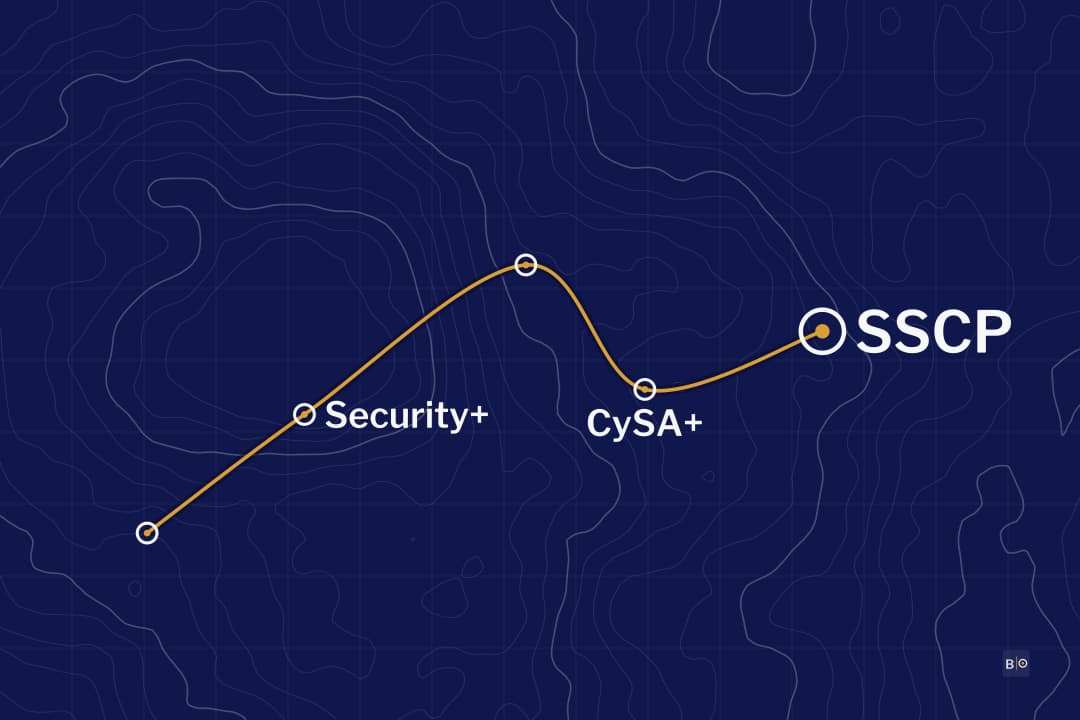
Match the certification to the work role you want next, not the one you're leaving. CompTIA maps Security+ to the cyber defense analyst and incident responder roles, and it lists CySA+ as meeting 8140 requirements for analysts with about four years of experience. SSCP suits administrators; ISC2 lists it as approved under DoDM 8140.03, and it needs one year of experience, which a cyber billet may already give you. PenTest+ maps to 8140 roles such as exploitation analyst. Senior people should look at CISSP, which needs five years in two of its eight domains and costs $749 to sit.
On cost, we'd use CA or its equivalent for the cheaper exams while serving, then claim the GI Bill for a costly one like CISSP after separation, so each program pays for what it covers best. Clearance holders should also read our guide to government security certifications.
Sources
-
Army COOL benefit fact sheet: March 2026 officer eligibility, credential limits and funding policy, checked October 2026
-
DoD 8140 FAQ, Workforce Innovation Directorate: effective date, qualification deadlines, who is covered, DFARS 239.71, carry-over of 8570 certifications, checked October 2026
-
Sample DCWF Work Role Qualification Matrix: foundational, residential and continuous development requirements, proficiency levels, checked October 2026
-
DoD CIO: Cyber Workforce: DCWF and the seven workforce elements, checked October 2026
-
NICCS NICE Framework: Defensive Cybersecurity: task statements, checked October 2026
-
NICCS NICE Framework: Systems Administration: task statements, checked October 2026
-
DoD COOL: branch COOL sites and occupation-to-credential research, checked October 2026
-
Army COOL: Army Credentialing Assistance: covered costs, funding limits, one goal per year, checked October 2026
-
Army COOL: Costs and Funding: ArmyIgnitED requests, no reimbursement, checked October 2026
-
USMAP: registered apprenticeship through recorded on-the-job hours, checked October 2026
-
SkillBridge: Military Members: eligibility, commander approval, pay and benefits, no provider wages, checked October 2026
-
SkillBridge: Program Overview: program types, written authorization, checked October 2026
-
SkillBridge home page: first-quarter 2026 provider and position counts, checked October 2026
-
VA: Licensing and certification tests: $2,000 per test, entitlement charging, prep courses, VA Form 22-0803, checked October 2026
-
VA: VET TEC 2.0: eligibility, what it pays, fields, openings, checked October 2026
-
CompTIA Security+ V7: DoD 8140 work roles, checked October 2026
-
CompTIA CySA+ V4: DoD 8140 and recommended experience, checked October 2026
-
CompTIA PenTest+: DoD 8140.03M work roles, checked October 2026
-
ISC2 SSCP: one year of experience and DoDM 8140.03 approval, checked October 2026
-
ISC2 CISSP Experience Requirements: five years in two domains, checked October 2026
-
ISC2 Exam Pricing: $749 CISSP registration, checked October 2026