A security certification, a DoD cyber-workforce qualification and a personnel security clearance are separate matters. A job can require more than one, but passing an exam does not grant a clearance. Start with the position's work role and the employer's requirements, then identify which qualification you can obtain yourself and which process the employing organization must initiate. That distinction prevents an expensive certificate purchase from answering the wrong question.
Read the vacancy as several separate requirements
Identify the actual work first: administration, security operations, control assessment, architecture or another specialty. Then separate qualifications the employer requires at entry from those it permits a new employee to complete. Record any clearance or suitability wording separately rather than grouping it with the certification list.
NIST's NICE Framework provides a public vocabulary for cybersecurity tasks. The DoD Cyber Workforce Framework and the 8140 qualification program serve a related defense-workforce purpose. A familiar commercial job title may map to several responsibilities, so ask for the coded work role and proficiency level when the vacancy depends on DoD 8140.
Federal civil-service hiring also has occupation and grade requirements. OPM's IT Management series qualification standard describes education and experience routes for covered IT positions. A credential may contribute to a particular route without replacing every experience requirement. Read the announcement and ask the hiring contact how the listed requirements are applied.
Understand what replaced the old 8570 checklist
DoD Manual 8140.03 establishes qualification requirements by work role and proficiency level. The department's FAQ says the old DoD 8570 certifications carried into the newer program and were aligned to appropriate roles and levels. That does not mean every accepted certification is interchangeable for every position.
The published sample matrix separates foundational knowledge, residential qualification and continuing professional development. Foundational options include education, training and personnel certification, with experience as a conditional alternative. Residential qualification addresses capability in the environment and includes on-the-job requirements set by the component.
Ask the employer which option applies to the specific role. A certification may satisfy the foundational part while leaving local qualification work to complete. The military transition guide explains how this affects people moving from a military billet to contractor or civilian work.
Choose the certification for the role
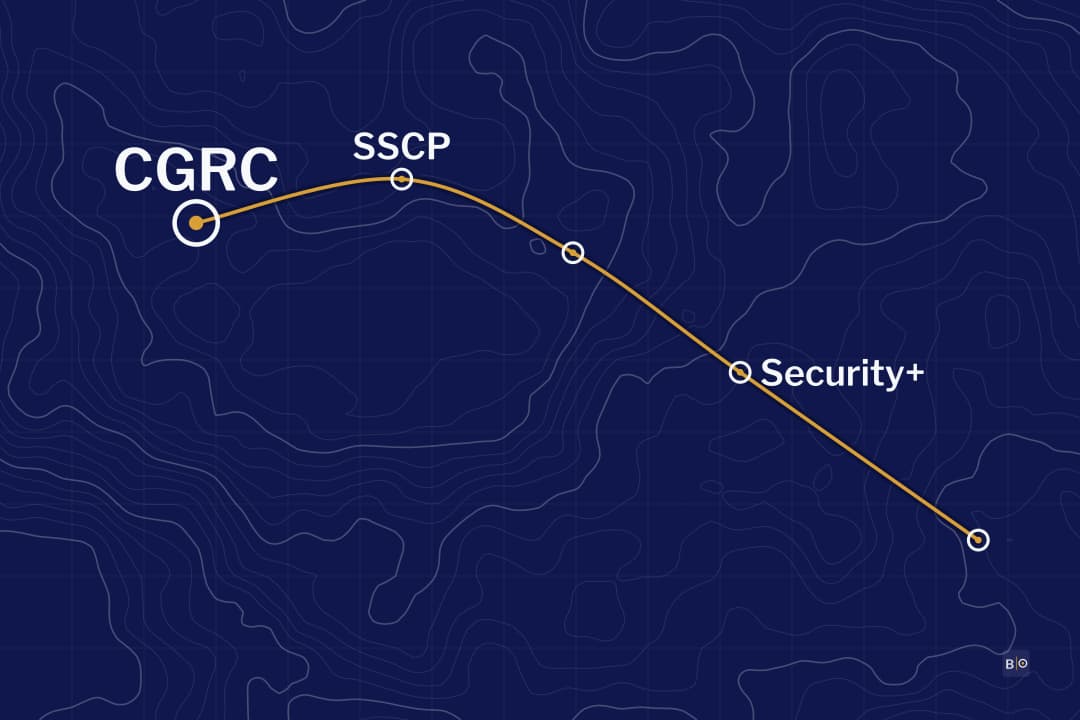
Security+ can be relevant to entry and intermediate technical roles because CompTIA maps it to several DoD work roles. Check the current matrix and the employer's requirement rather than treating the credential as a universal ticket into defense employment. Experience and other position requirements still matter.
SSCP fits security administration and operations. ISC2 requires a year of qualifying experience or an accepted degree pathway. A candidate without either may pass the exam and apply for Associate of ISC2 status while gaining the experience. The certification requirement is separate from the employer's authorization to work on a particular system.
CGRC, formerly CAP, fits control-assurance and system-authorization responsibilities. ISC2 requires two years of qualifying experience for the full credential. CISSP fits broader experienced security work and normally requires five years across at least two domains, subject to its maximum one-year waiver. Choose the stage that matches the responsibilities, not the most senior title on a list.
A clearance starts with the employing organization
DCSA's adjudications FAQ says the employing organization determines whether a position requires access to classified information and initiates clearance processing when needed. An individual certification does not make that determination. A prospective employee should ask the employer about sponsorship and the exact position requirement rather than trying to buy clearance eligibility through training.
Follow the official process and provide the information it requests accurately. A career article cannot predict the result for an individual applicant or promise a processing time. Those depend on the applicable process and the person's circumstances. Direct case-specific questions to the employing security office and official guidance.
A job's technical qualification and its clearance process may proceed on different schedules. Ask which conditions must be satisfied before starting the role and which before receiving particular access. A conditional offer does not by itself settle every authorization question. Keep the employer's written requirements available while planning training and a possible move.
Build evidence for the work you can perform now
Choose a project relevant to the target task: a documented access review for administration, an incident analysis for operations or a control assessment for assurance. Use an authorized lab and keep sensitive employer information out of the portfolio. Show the method, evidence and limits of the result.
For federal applications, describe qualifying work in the terms the announcement asks reviewers to assess. A title alone can conceal relevant responsibility. Record what you did, the systems involved at an appropriate level of disclosure and how the work was reviewed. The no-degree route discusses the education and experience distinction in more detail.
For contractor roles, ask the employer about training funding and qualification deadlines. The DoD FAQ says components should not pay for contractors to obtain or retain required certifications, while allowing additional local or DoD-specific training. Do not assume a government training budget will cover a personal exam purchase; clarify the contractor employer's policy before paying.
Keep the next decision tied to the vacancy
Make a short requirement record for each target role: duties, qualification route, required credentials, experience, clearance conditions and who can answer unresolved questions. Compare that with what you already hold. The next purchase should close an identified gap rather than respond to a generic list of government certifications.
We would pursue a realistic work-role qualification and a reviewed project while applying to suitable roles. Let the employer initiate any clearance process the position requires. The IT-to-security path fits candidates building the underlying experience, while the GRC specialist route fits those drawn to authorization and assessment. Neither route guarantees access to classified information, and neither needs that promise to be a useful career plan.
Sources
- DoD 8140 FAQ: role alignment, legacy certifications and contractor funding, checked October 2026
- DoD sample qualification matrix: qualification components, checked October 2026
- DCSA adjudications FAQ: employer initiation of clearance processing, checked October 2026
- OPM 2210 qualification standard: education and experience routes, checked October 2026
- NICE Framework resource center: task vocabulary, checked October 2026
- CompTIA Security+ V7: DoD role mappings, checked October 2026
- ISC2 SSCP experience: degree and Associate routes, checked October 2026
- ISC2 CGRC experience: two-year rule, checked October 2026
- ISC2 CISSP experience: five-year rule and waiver, checked October 2026