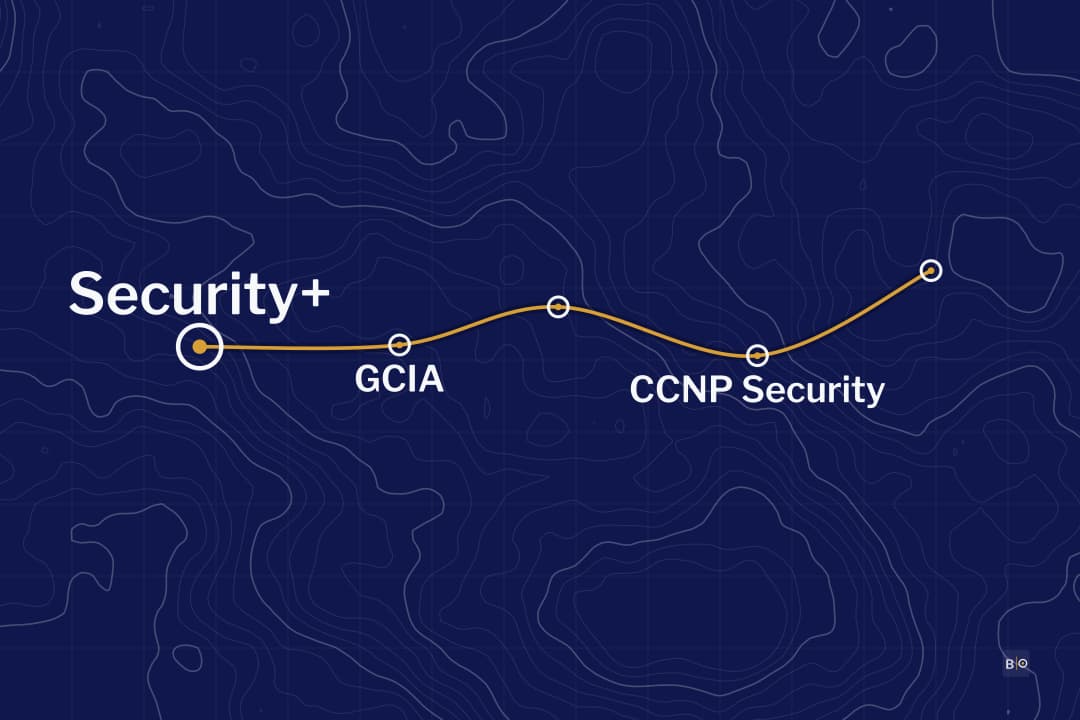
Access control lists, IPsec VPNs and RADIUS are already in the CCNA's Security Fundamentals domain, so an engineer who studied for the CCNA has already learned security work without the title. What you have to choose is a direction. You can stay on the building side and run the firewalls, VPNs and access control that protect a network, or move to the watching side and analyze its traffic for attackers. The certifications split along the same line, and a CCNA already counts toward one of them.
A short move in the NICE Framework
The NICE Workforce Framework (NIST SP 800-181) describes a network engineer's job as Network Operations (IO-WRL-004): diagnose connectivity problems, configure and optimize routers and switches, integrate new systems, monitor capacity and performance. The neighbouring security role is Infrastructure Support (PD-WRL-004), defined as testing, deploying, maintaining and administering the hardware and software used for cybersecurity. Its tasks include administering VPN devices, applying rule and signature updates to cyber defense applications, and administering those systems day to day.
In NICE terms that's a short step. The equipment is often the same, a firewall or a VPN concentrator, and what changes is the purpose of the configuration. If you want to analyze rather than build, the target is Defensive Cybersecurity (PD-WRL-001), whose tasks include identifying anomalous network activity. A network engineer usually knows what normal traffic looks like on their own network, and that knowledge is what spotting the abnormal depends on.
What your CCNA already counts toward
Cisco's CCNA (200-301, $300, 120 minutes) gives Security Fundamentals 15% of the exam: key security concepts, access control lists, Layer 2 protections such as port security and BPDU guard, RADIUS and TACACS+ for device access, and remote access and site-to-site IPsec VPNs. The CCNA isn't a security certification, but those objectives are security work.
It also has value at ISC2. The CCNA is on ISC2's list of credentials that waive one of the five years of experience the CISSP requires, alongside CCNP Security, Security+ and SSCP. For defense work, the DoD 8140 FAQ notes that Cisco folded the old CCNA Security into the CCNA and that the department issued a waiver covering people who held CCNA Security in a DoD 8570 position.
If your employer needs a vendor-neutral credential, Security+ is the one to add. CompTIA maps it to DoD 8140 work roles including network specialist and cyber defense analyst, and passing it renews Network+ if you hold that too, because Security+ sits higher in CompTIA's certification hierarchy.
Direction one: network security engineering
This route keeps you building. On a Cisco network the credential that matches the work is CCNP Security, which takes two exams: the SCOR 350-701 core ($400, 120 minutes) and one 90-minute concentration ($300). Cisco replaced the core with SCOR v2.0 on August 27, 2026, so check the version on any study material. Network Security is its largest domain at 25%, with objectives on access control, intrusion prevention and URL filtering on Secure Firewall, site-to-site and remote access VPNs, and troubleshooting tunnels that won't come up. The concentrations now cover firewalls (SNCF 300-710), identity with ISE (SISE 300-715), secure access (SSCA 300-740) and design (SDSI 300-745). The certification lasts three years.
The engineering route suits you if you'd rather design a segmentation scheme than read alerts, and if your employer standardizes on one vendor's security products. Its weakness is portability. If your next employer doesn't run Cisco, the hands-on objectives won't carry over, and Security+ or CISSP will tell a hiring manager more.
Direction two: network detection and analysis
This route turns your protocol knowledge into an analyst's skill. Cisco's own entry point is the Certified Cybersecurity Associate, formerly CyberOps Associate (200-201 CBROPS v1.2, $300, 120 minutes). Security Monitoring carries 25% and Network Intrusion Analysis 20%. That domain asks you to map events to intrusion detection, firewall, proxy and NetFlow sources and to tell true positives from false ones.
The deeper credential is GIAC's GCIA: 106 questions in four hours, including hands-on CyberLive items, for $999. Seven of its 15 objectives are about protocols, and two ask you to produce something: tcpdump filters that match given criteria, and intrusion detection system (IDS) rules for malicious traffic. A network engineer who has spent years in packet captures has a head start on it. Later, if incident work draws you in, GNFA covers reconstructing an attack from proxy logs, NetFlow and packet captures after the fact.
The two routes side by side
| Network security engineering | Network detection and analysis | |
|---|---|---|
| NICE work role | Infrastructure Support (PD-WRL-004) | Defensive Cybersecurity (PD-WRL-001) |
| First credential | Security+, or CCNP Security on a Cisco network | Cisco Certified Cybersecurity Associate or Security+ |
| Deeper credential | CCNP Security concentration in your product area | GCIA, then GNFA |
| Ready to move when | You've owned a firewall rule base or a VPN rollout end to end | You can write a tcpdump filter and an IDS rule for a given attack without notes |
Doing the move inside your current job
Both routes start with the same step at work: take the security-flavored network tickets. Firewall change requests, VPN problems and 802.1X rollouts build the engineering route; helping the SOC pull packet captures during an investigation builds the detection route. Keep a dated record of that work. ISC2 can count it toward experience where it falls within a certification's domains, and it gives you specifics for interviews.
If you're still in a support role and networking is new, our IT-to-security route starts a step earlier. For a wider survey of network security credentials, see our network security certifications overview, and for the analyst career after the move, the SOC analyst ladder.
Our view
The engineering route is the more familiar of the two. We'd lean toward detection for anyone who enjoys packet analysis, because protocol fluency is hard to teach analysts and easy to show on GCIA. If your network runs Cisco and you'd rather keep building, CCNP Security fits the work you already do. Either way, add Security+ or plan for CISSP so your résumé reads clearly outside one vendor's ecosystem.
Sources
- NICCS NICE Framework: Network Operations work role: IO-WRL-004 description and tasks, checked October 2026
- NICCS NICE Framework: Infrastructure Support work role: PD-WRL-004 description and tasks, checked October 2026
- NICCS NICE Framework: Defensive Cybersecurity work role: PD-WRL-001 tasks, checked October 2026
- Cisco: CCNA certification: 200-301 exam, $300, 120 minutes, checked October 2026
- Cisco: CCNA 200-301 v1.1 exam topics (PDF): domain weights and Security Fundamentals objectives, checked October 2026
- ISC2 CISSP Experience Requirements: one-year waiver list including CCNA and CCNP Security, checked October 2026
- DoD 8140 FAQ: CCNA Security conversion and waiver, checked October 2026
- CompTIA Security+ V7: DoD 8140 work roles, checked October 2026
- CompTIA Continuing Education Program FAQ: certification hierarchy and renewal by higher certification, checked October 2026
- Cisco: CCNP Security certification: core and concentration exams, prices, durations, three-year validity, checked October 2026
- Cisco Blogs: Cisco Security Certification Updates, Your Questions Answered: SCOR v2.0 dates and concentration changes, checked October 2026
- Cisco: SCOR v2.0 exam topics (PDF): domain weights and Network Security objectives, checked October 2026
- Cisco: Cybersecurity Associate exam and training: 200-201 CBROPS v1.2, $300, 120 minutes, name change, checked October 2026
- Cisco: 200-201 CBROPS v1.2 exam topics (PDF): domain weights and Network Intrusion Analysis objectives, checked October 2026
- GIAC Certified Intrusion Analyst (GCIA): questions, time, CyberLive, objectives, checked October 2026
- GIAC Pricing: $999 attempt, checked October 2026
- GIAC Network Forensic Analyst (GNFA): scope, checked October 2026