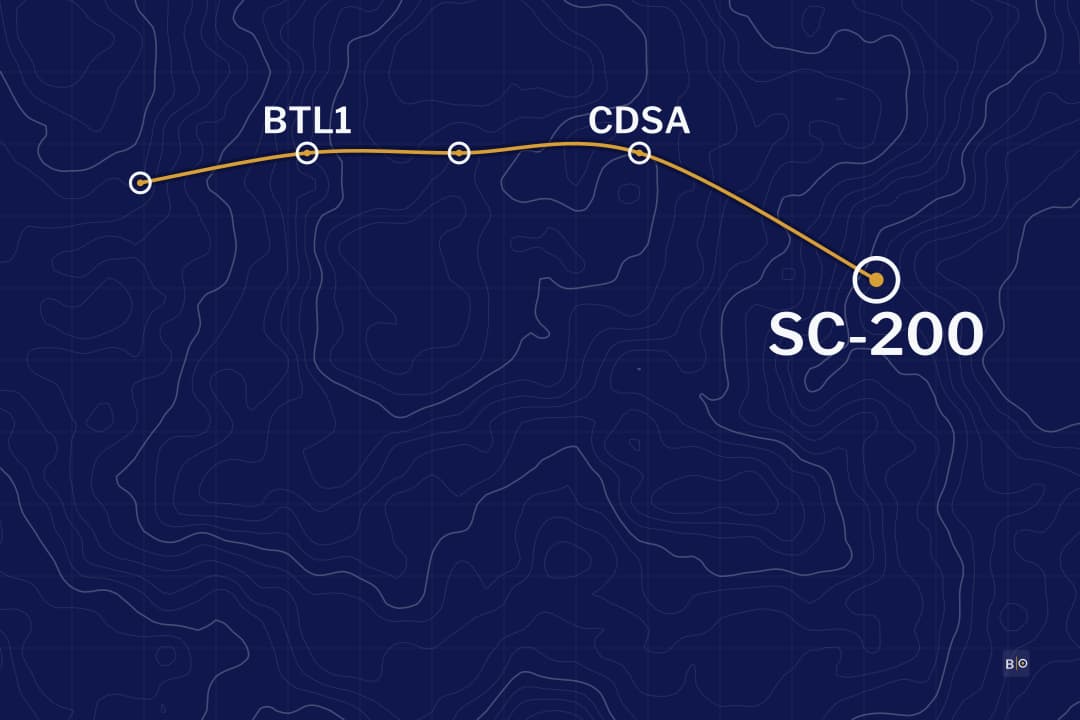
The analyst who closes alerts fastest is not automatically ready to lead a security operations center. A better progression starts with accurate triage, moves into complete investigations and detection improvement, then branches into technical ownership or people management. Employers use tier labels differently. Use the work you can own without rescue, together with the evidence behind it, to choose the next role and certification.
Make the first alert handoff reliable
At the start, learn the environment behind the queue. Find out which systems are important, which identities administer them and where the logs come from. A sign-in alert can mean something different for a service account, a privileged administrator and a user travelling for work. The rule name is only the beginning of the investigation.
NIST's NICE Framework describes Defensive Cybersecurity as analysis of information from defense tools to reduce risk. Turn that broad task into a repeatable handoff: the activity observed, the evidence checked, the likely explanation, uncertainty and the action needed. Write the note so the next shift can continue without repeating your work.
Ask a senior analyst to review decisions you closed as benign as well as those you escalated. That makes missing evidence visible before a serious case depends on it. You are ready for more responsibility when your notes show why a decision was reasonable at the time, including what information you did not have.
Use an early practical credential to test the investigation
BTL1 is one way to test this stage. Centri's exam gives candidates access to a compromised lab and task-based questions. It checks whether you can use evidence from the tools rather than only recognize terms. Read the course and exam access windows before buying, especially if you study around shift work.
HTB CDSA adds a report-centered investigation after its mandatory SOC Analyst learning path. Hack The Box's current subscriptions page lists the standalone voucher at $210. The report matters because it forces you to connect findings across the environment and explain what happened in a form someone else can assess.
Choose one practical credential rather than taking both automatically. If your current job already gives you reviewed investigations, identify the specific gap the course would fill before paying. The self-taught route compares these options for people who need lab evidence before their first analyst job.
Own an investigation beyond the initial alert
The next stage begins when you can define the question an alert raises and gather the evidence needed to answer it. Build a timeline, identify affected accounts and systems, and distinguish confirmed activity from a plausible hypothesis. If important telemetry is missing, record that limitation where the conclusion depends on it.
NIST SP 800-61 Revision 3 places detection, response and recovery within wider cybersecurity risk management. For an analyst, that means understanding who can authorize containment and how operational consequences enter the decision. You may recommend disabling an account without being the person authorized to interrupt the service it runs.
Finish the case by checking what recovery established. A reimaged endpoint does not answer whether an exposed credential is still valid elsewhere. Ask what evidence would show that the original access path is closed. Our incident response career path covers the branch where that end-to-end responsibility becomes the main job.
Add the platform exam when you use its tools
SC-200 fits a SOC using Microsoft Defender XDR and Sentinel. Microsoft's objectives cover managing the security operations environment, responding to incidents and threat hunting. The English exam updates on October 21, 2026, so candidates booking after that date should use the new skills list.
Make the preparation operational. Write a Kusto Query Language investigation that starts with a suspicious identity and follows its activity through the available data. Explain the tables and time boundaries you use, and check whether missing logs could produce a false negative. Have another analyst run the query on a different case.
CySA+ provides a vendor-neutral analyst syllabus. CompTIA recommends about four years of relevant experience for the current exam, while imposing no formal prerequisite. English CS0-003 retires on December 22, 2026; someone beginning now should compare the current CS0-004 objectives with the work they need to learn. A version decision should precede buying an old course bundle.
Turn repeated investigations into better detections
Technical progression often means improving what reaches the queue. Choose a recurring false positive or a case the SOC detected late. Inspect the data source, rule logic and expected behavior before editing the threshold. A quieter queue is not useful if the change also suppresses the activity you need to find.
Build a controlled test with positive and negative cases. Record the rule version and the reason for the change, then watch what happens after deployment. Include a rollback condition. Detection ownership connects analysis with engineering because another analyst now depends on your work before their investigation starts.
This branch can lead to detection engineering or threat hunting without people management. The blue team specialist route describes that progression. Ask whether a prospective senior analyst role includes time to improve detections or merely a larger share of the alert queue.
Decide whether you want to manage the team
A SOC manager owns staffing, escalation arrangements, service coverage and the conditions under which analysts work. Practise those responsibilities in a bounded assignment such as improving shift handover or running a detection review. Listen to the analysts who inherit the change; a process that is easy on paper can create more work on the night shift.
CISM belongs when your role becomes program management. ISACA requires qualifying management experience, so a good analyst record alone does not establish eligibility. Its November 2026 outline change also matters to anyone starting study now. Keep the credential decision tied to actual responsibility for the service.
We would choose the technical branch first if you still prefer investigating and building detections. Managing people is a different job that deserves a deliberate choice. In either branch, keep examples of how your work improved the next analyst's decision: a clearer case record, a tested detection or an escalation process that reached the right owner.
Sources
- NICE Defensive Cybersecurity: analyst task reference, checked October 2026
- Centri BTL1: practical credential, checked October 2026
- HTB CDSA: learning path and report format, checked October 2026
- HTB Academy subscriptions: standalone voucher price, checked October 2026
- Microsoft SC-200 study guide: objectives and October update, checked October 2026
- CompTIA CySA+: version retirement, checked October 2026
- CompTIA CySA+ V4: current exam audience and experience, checked October 2026
- NIST incident response Revision 3: risk-integrated incident work, checked October 2026
- ISACA CISM: management credential and outline transition, checked October 2026