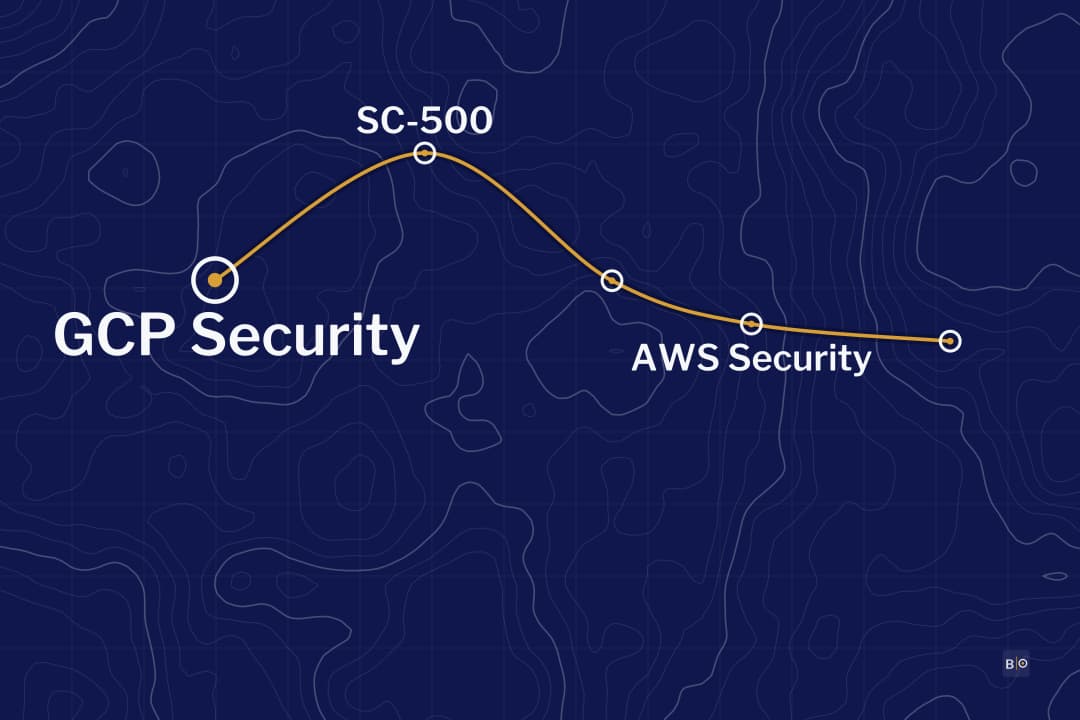
Cloud security engineering starts with the account that deploys the workload and the evidence that explains what it did. A useful route therefore begins in platform administration, then adds identity controls, repeatable deployment checks and incident handling. Choose one provider to work on first. A vendor-neutral cloud certification becomes more useful when you are answering questions about several services, providers or business units.
Learn the platform as an operator
Before building security controls, deploy a small application and operate it. Set up its network, data store, identity and logging. Make a change, inspect the result and reverse it. The point is to see what happens when a service is unavailable, a permission is missing or a deployment creates a resource somewhere you did not expect.
Keep a record of the resources and their owners. A security policy that refers to an account no one administers will be difficult to enforce when an incident occurs. Include the people and automated identities that can change the environment, including deployment pipelines and support accounts. Access has to be issued, reviewed and removed throughout a workload's life.
NIST's NICE Framework separates infrastructure support from architecture and incident response. Cloud jobs often combine parts of those roles. Use the task descriptions to identify your gap rather than assuming a job called cloud security engineer is always senior. Some teams need an operator who can improve controls; others need an architect who can set the design for many operators.
Make identity the first security project
Use the application to trace who can read its data, deploy a release and change its permissions. Prefer a design that lets you identify the person or service responsible for each action. Test the removal path as well as the access request. A temporary account that remains powerful after the project ends is a useful example of a lifecycle failure.
Then examine workload access. Document which service talks to which other service and the permission it needs. Test a denied request and make sure the error reaches someone who can diagnose it. A least-privilege policy that breaks the application during recovery will be widened quickly unless the operating team has a workable alternative.
These are practice projects, not a claim that one identity design fits every provider. Read the provider's guidance for the service and deployment model you use. The certification outline is a syllabus for the breadth you need, while the service documentation determines the exact implementation. Keep those two reading habits separate.
Choose the provider exam that matches your environment
For AWS, Security Specialty now uses SCS-C03. AWS's guide covers detection, incident response, infrastructure security, identity and access, data protection and governance. AWS recommends substantial security and AWS experience but sets no certification prerequisite. Build the identity and logging projects before treating a practice-test score as evidence you can secure an AWS organization.
For Microsoft environments, the catalog's Azure security page now covers SC-500, the Cloud and AI Security Engineer Associate route. Microsoft retired AZ-500 and the Azure Security Engineer Associate certification on August 31, 2026. Starting now, study the SC-500 objectives rather than buying an old AZ-500 course because its name matches the job title.
For Google Cloud, Professional Cloud Security Engineer covers the equivalent platform responsibilities. Google's current guide also includes AI workload and software supply-chain security. Pick it when you can use the material on Google Cloud, not as a second provider badge before you have operated the first. Our AWS certification roadmap offers more detail for an AWS-focused role.
Turn a working control into a guardrail
The next stage is making the secure choice repeatable. Put a deployment check around a control you understand: required logging, restricted administrative exposure or an approved identity pattern. Define how the check handles an existing exception and how a team asks for a new one. A rule that only produces a warning no one owns is still an unfinished control.
Test the check against a deliberately bad deployment and a valid deployment that looks unusual. Record why each result is correct. If the check blocks production, provide a controlled recovery process and a way to identify who used it. This is where cloud engineering meets the DevSecOps route.
Ask the platform team to run the check without your help. Their questions will reveal missing assumptions, unclear error messages and permissions your test account had by accident. You are ready for broader responsibility when another team can use the control and you can show what it detects, what it misses and how those limits are reviewed.
Practise response in the environment you built
NIST SP 800-61 Revision 3 places incident response within ongoing cybersecurity risk management. For a cloud project, start with a scenario such as a compromised deployment identity. Work out which logs establish the activity, who can revoke access and what legitimate work will break when you do.
Run the exercise in your own authorized environment with a safe test account. Preserve the evidence before changing the account or deleting resources. Test the recovery path and note where your original design made response difficult. This gives you a project that connects platform engineering to operational outcomes rather than ending at a screenshot of a successful deployment.
Use the incident to improve the guardrail. Perhaps the account needed a shorter access window, or the team could not find its owner. A cloud engineer's work becomes more valuable when the same finding improves identity management, deployment checks and the response procedure. That is a better reason for advancing than learning another console.
Add CCSP when the decisions cross provider boundaries
CCSP is useful when your responsibilities include data handling, assurance reports, provider contracts and risk decisions as well as service configuration. ISC2 normally requires five years in IT, including three in cybersecurity and one in a CCSP domain. A relevant degree or CCSK can replace a maximum of one year; an active CISSP can satisfy the entire requirement.
We would choose a provider credential first for an engineer building and operating controls, then CCSP when the work broadens. Someone already assessing cloud services across an organization could reasonably reverse that order. Keep the portfolio either way: the application, identity review, deployment control and response exercise show the work behind the certification. The analyst-to-architect route covers the next move toward owning larger design decisions.
Sources
- NICE Infrastructure Support: operational security tasks, checked October 2026
- AWS Security Specialty: current certification and recommended background, checked October 2026
- AWS SCS-C03 guide: exam scope, checked October 2026
- Microsoft Cloud and AI Security Engineer: SC-500 certification, checked October 2026
- Microsoft retired Azure Security Engineer: August 31 retirement, checked October 2026
- Google Cloud Security Engineer: provider certification and scope, checked October 2026
- NIST incident response Revision 3: response integrated with risk management, checked October 2026
- CCSP experience requirements: experience and substitutions, checked October 2026