Blue team work extends beyond the alert queue. Someone has to configure the controls, make their evidence usable and repair the weaknesses an investigation reveals. Begin with one part of that system and learn how it affects the others. You can become a senior defensive specialist through engineering, detection or investigation without moving into people management or collecting every credential with a defensive label.
Choose the system you want to keep working
NIST's NICE Framework distinguishes Infrastructure Support from Defensive Cybersecurity and Incident Response. The first emphasizes operating the technology used for defense; the others concern analysis and response. A blue team job can combine these tasks, so ask what the employer expects you to own during an ordinary week.
For a systems administrator, an identity or endpoint control may be the shortest route into security engineering. For a network engineer, it may be the telemetry and filtering around traffic. An analyst may move in the other direction by improving the rule or logging source behind a repeated investigation.
Pick a bounded service and document its owner, purpose and dependencies. A control with no recovery process or accountable owner becomes difficult to trust when it fails. The first project should leave another person able to operate it, not merely demonstrate that you can configure it while your administrator session is still open.
Use SSCP to organize the operating foundation
SSCP fits administrators and junior engineers who implement and operate security controls. ISC2's outline includes access control, monitoring, incident response, cryptography, network security and systems security. It requires a year of qualifying experience or an accepted degree pathway; candidates without either can use the Associate of ISC2 route.
Study a domain alongside the system you operate. If the topic is access control, examine account creation, privilege assignment, review and removal. Test the point where a user changes role rather than only the point where they first receive access. A permission that was once appropriate may remain active after the business need ends.
For a networking background, our network-to-security route provides a more specific branch. An existing administrator should avoid repeating beginner exams solely because a generic roadmap lists them. Choose the syllabus that exposes gaps in the service you are responsible for.
Make telemetry part of the control design
A control should generate evidence that helps explain its behavior. Choose a relevant security event, verify that it is recorded and follow it into the system analysts use. Check the identity, host and timestamp fields before writing a detection around them. A broken field mapping can make a plausible rule ineffective.
Give the operating team a way to detect a missing source. The absence of suspicious activity is different from the absence of data, and the monitoring design needs to make that distinction visible. Record what happens when the collector fails or a new system is deployed without the expected configuration.
MITRE ATT&CK can help describe the behaviors you want the evidence to reveal. Use a technique as a test question, not a colored square that proves the organization is covered. The test needs to establish that the behavior occurred, the data arrived and the analyst could interpret the resulting signal.
Choose the next credential by the evidence gap
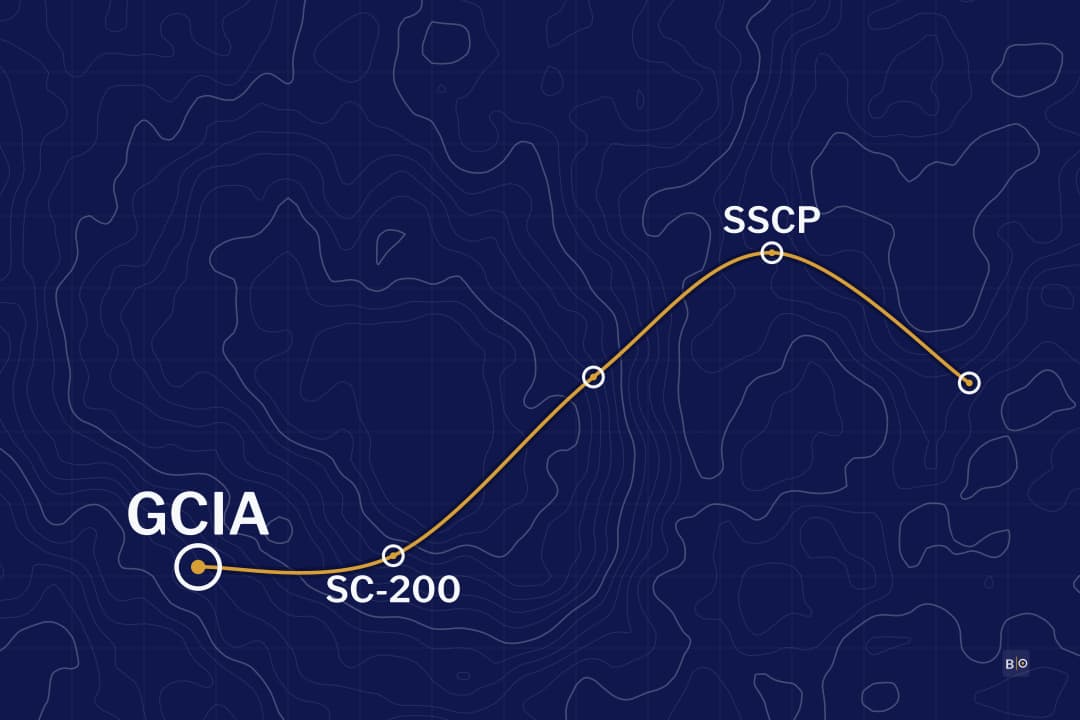
SC-200 is useful for a Microsoft environment where Defender XDR and Sentinel provide the operational tools. Microsoft's English exam updates on October 21, 2026. The current objectives are the right starting point for a study plan involving investigations, hunting and the security operations environment.
GCIA suits the network-analysis branch. GIAC's objectives cover protocols and intrusion analysis, including the evidence and rules that make traffic useful to defenders. A network engineer may find that closer to existing strengths than a general cloud or management credential.
GCFA belongs where host and memory analysis repeatedly limits an investigation. It is a deeper forensic branch, not the inevitable next exam for every defender. The forensics route explains how that specialization develops, while the SOC progression guide covers the investigation queue.
Practise the response your design makes possible
NIST SP 800-61 Revision 3 connects response with cybersecurity risk management. Read it while considering the service you own. If an administrative identity is compromised, which evidence supports the decision, who can revoke it and what business function may be interrupted? Those questions belong in the design before an emergency.
Run a controlled exercise in an authorized environment. Check whether the responder can identify the affected identity, find its owner and follow the recovery procedure. Record which steps required information outside the runbook. The useful result is an improvement request with an owner, not only a statement that the exercise was completed.
Follow the repair through deployment and test it again. A new log source or a cleaner access-removal process can improve several later investigations. That is a credible senior contribution because it changes how the team handles the next case, rather than merely increasing the number of tools available.
Become the reviewer for a defensive service
A senior specialist can review changes to the control and explain their consequences across teams. Practise evaluating a proposed rule, permission change or collector update. Ask what requirement it serves, what could fail and how the operating team would recognize the failure.
Keep a record of decisions and their test evidence. It gives a new engineer a starting point and helps you notice when the original assumptions no longer apply. A service designed for one deployment model may need different controls when the application or identity source changes.
We would build depth in one service, then expand along its dependencies. The strongest next credential is the one that makes a repeated blind spot easier to resolve. If you prefer coordinating the test between operators and analysts, the purple team path is a good direction. If you prefer making the response repeatable in code, look at security automation.
Sources
- NICE Infrastructure Support: operational control responsibilities, checked October 2026
- NICE Defensive Cybersecurity: analysis role, checked October 2026
- ISC2 SSCP outline: operational domains, checked October 2026
- ISC2 SSCP experience: degree and Associate routes, checked October 2026
- Microsoft SC-200 study guide: current platform objectives, checked October 2026
- GIAC GCIA: network analysis, checked October 2026
- GIAC GCFA: host and memory analysis, checked October 2026
- MITRE ATT&CK: behavior reference, checked October 2026
- NIST incident response Revision 3: response context, checked October 2026